People have visited the Garden of the Gods for thousands of years, with archaeological evidence of prehistoric visits dating to about 1330 BC and of camps sheltered beneath rock overhangs by around 250 BC. The park lies within the homeland of the Ute people, whose oral traditions place their origins in Colorado and who call Pikes Peak Tava, or Sun Mountain. Before about 1870, Ute bands came down from the west in winter to shelter among the rocks and hunt deer, turkey, elk and bison, and the Ute Trail passed through the area toward Ute Pass. Apache, Cheyenne, Comanche, Kiowa, Lakota, Pawnee and Shoshone peoples are also associated with the site. In August 1859 two surveyors laying out nearby Colorado City explored the rocks; when Melancthon Beach suggested it would make a fine beer garden, Rufus Cable answered, "We will call it the Garden of the Gods." After the growth of homesteads and towns, the Ute were forced onto reservations.
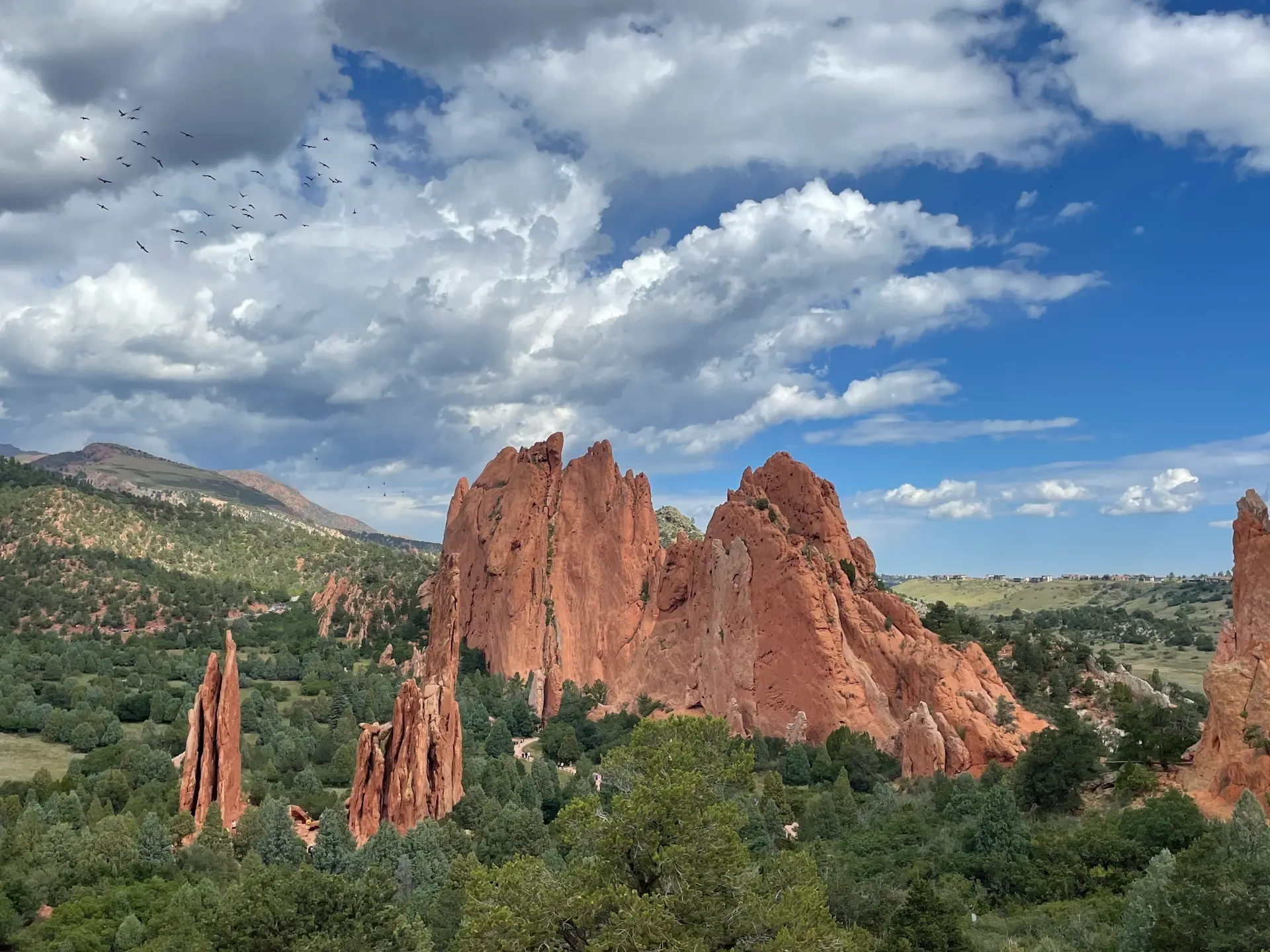 Photo: International Parks
Garden of the Gods
City Park · Colorado, United States
- Rating
- 72
- Established
- 1909
- Area
- 5.5 km²
About Garden of the Gods
Garden of the Gods is a free public park on the west side of Colorado Springs, Colorado, where towering fins and hogbacks of red, pink and white sandstone rise abruptly beneath the snow-capped summit of Pikes Peak. The park began as a 480-acre gift from the children of railroad executive Charles Elliott Perkins, who deeded the land to the city on December 22, 1909, on the condition that it remain free to the public forever. It has since grown to just over two square miles, and part of it was designated a National Natural Landmark in 1971. With more than two million visitors a year it is the most visited park in Colorado Springs, drawing walkers to its paved Central Garden, hikers to roughly 21 miles of trails, and permitted technical climbers to its vertical sandstone walls.
Been to Garden of the Gods? How was it?
Drag to rate. No account needed.
Photos
Add your photos1 / 4Photo: International ParksPark Information
The meeting of plains, foothills and rocky ridges gives Garden of the Gods a surprisingly varied animal community for a city park. Mule deer are the most commonly seen large mammals, and Rocky Mountain bighorn sheep, red and gray foxes, coyotes, bobcats and the occasional mountain lion or black bear also use the park. More than 130 bird species have been recorded, including white-throated swifts, swallows and canyon wrens around the rock fins, as well as red-tailed hawks, black-billed magpies and spotted towhees. Smaller residents include least chipmunks, cottontail rabbits, pack rats, little brown bats and prairie rattlesnakes. The park has even lent its name to science: a subspecies of honey ant discovered here in 1879 was named after the Garden of the Gods.
Several plant communities meet within the park, shaped by soil, rock type, slope and the area's limited rainfall. Piñon pine and one-seed juniper woodlands cover much of the rocky ground, mixed with Gambel oak, mountain mahogany, three-leaf sumac and wax currant on drier slopes. Open grassland and shrubland areas support yucca, prickly-pear cactus and wildflowers such as paintbrush, pasque flower and prairie coneflower, while moister, shaded spots hold ponderosa pine, chokecherry, wild rose and Rocky Mountain penstemon. Many of these plants were important to the Ute people, who used yucca, three-leaf sumac and piñon pine for food, medicine and everyday materials. Rock surfaces, crevices and the base of the sandstone fins create small microhabitats where plants find shelter from wind and sun.
The park's famous formations are layers of sedimentary rock that were laid down horizontally and later tilted to vertical and in places beyond vertical, exposing rocks that elsewhere lie deep underground. The oldest prominent layer is the Fountain Formation, 320 to 300 million years old, a coarse conglomerate, sandstone and mudstone more than 4,500 feet thick that washed off the Ancestral Rockies in alluvial fans; it forms the western rocks, including Balanced Rock. The Lyons Formation, deposited 300 to 260 million years ago when the area was a windswept desert of sand dunes, makes up the tallest rocks, North and South Gateway, White Rock and Gray Rock; iron oxide gives its lower member a red color, while its upper member is white. Younger units include the Lykins and Morrison formations, Dakota Sandstone, Niobrara Formation and Pierre Shale. Beginning about 70 million years ago these layers were broken and tilted upright as the Rocky Mountains rose, and erosion has since carved the ridges and valleys seen today.
Garden of the Gods shares the semi-arid climate of Colorado Springs, which receives only about 16.5 inches of precipitation a year, most of it in summer as brief showers and afternoon thunderstorms. Winters are comparatively dry, with occasional snow. Because the sandstone weakens when saturated, technical climbing is prohibited whenever the rock is wet or icy, so storms and snow directly affect what visitors can do. The park keeps longer opening hours in the warmer half of the year, from 5:00 a.m. to 10:00 p.m. between May 1 and October 31, and closes an hour earlier from November through April.
The park owes its existence to Charles Elliott Perkins, head of the Chicago, Burlington and Quincy Railroad, whom Colorado Springs founder William Jackson Palmer encouraged in 1879 to make a home among the rocks. Perkins bought land there for a summer residence and later added to it, reaching 480 acres, but he never built on it. After his death in 1907 his children carried out his wish, and on December 22, 1909, they deeded the land to Colorado Springs. The deed required that the park remain free to the public, barred the manufacture or sale of alcohol, and limited buildings to those needed to maintain it as a park. The city has since enlarged the park to just over two square miles. On October 6, 1971, part of it was designated a National Natural Landmark, a visitor and nature center opened just outside the park in 1995, and in 2011 the American Planning Association honored it in its Great Places in America program.
The heart of the park is the Central Garden, explored by the Perkins Central Garden Trail, a paved, wheelchair-accessible loop of about 1.5 miles that begins at the North Parking Lot off Juniper Way Loop and passes beneath the great Lyons sandstone walls of North and South Gateway Rocks. Across the park, about 21 miles of trails lead to landmark formations including Balanced Rock, a popular photography stop, as well as Steamboat Rock, the Three Graces, Cathedral Spires, the Siamese Twins and the Kissing Camels perched atop a hogback. The vertical fins are a well-known technical climbing destination, open to climbers who obtain an annual permit from the City of Colorado Springs, climb in parties of two or more with proper equipment, and follow the park's technical climbing regulations. Next to the park, Rock Ledge Ranch Historic Site, once William Jackson Palmer's property, presents local history through a summer living history program.
Garden of the Gods lies on the west side of Colorado Springs, close to Manitou Springs, and is reached by city streets, with parking areas inside the park. Entry is free. The park is open from 5:00 a.m. to 10:00 p.m. between May 1 and October 31 and from 5:00 a.m. to 9:00 p.m. between November 1 and April 30. The Garden of the Gods Visitor and Nature Center, at 1805 North 30th Street just outside the park, is also free and houses about 30 educational exhibits, a short film on how the red rocks formed, a store and a café; a portion of their proceeds supports the Garden of the Gods Foundation. The center is open 9:00 a.m. to 6:00 p.m. from Memorial Day through Labor Day weekend and 9:00 a.m. to 5:00 p.m. the rest of the year, and closes on Thanksgiving, Christmas and New Year's Day. A replica of the Theiophytalia dinosaur skull found in the park is displayed there.
Protection of Garden of the Gods rests first on the conditions of the 1909 Perkins gift, which keep the park free to all, forbid alcohol sales and restrict construction to buildings needed for park maintenance. Its national significance was recognized in 1971, when part of the park was designated a National Natural Landmark. The park is also important to paleontology: the skull of the dinosaur Theiophytalia kerri, found here in 1878 by Colorado College professor James Kerr and identified as a new species in 2006, is the only known specimen of that species anywhere in the world. Because the sandstone is fragile, climbing is limited to permitted climbers following strict regulations and is banned when the rock is wet or icy, and unregistered climbers face fines. The park honors the Ute as the original people of the area and partners with them on education and park maintenance, while visitor center proceeds help fund the Garden of the Gods Foundation.
Ratings
Compare with other parks ›Garden of the Gods
Rated higher than 95% of parks on the site · strongest in Access and Safety
How rare and distinctive are the park's natural features compared with parks worldwide?
How dramatic is the landscape's scale and power? Consider sheer cliffs, deep canyons, big waterfalls, glaciers, and volcanoes.
How beautiful are the landscapes, vistas, and natural features?
How impressive and unique are the geological formations and features?
How diverse and unique is the plant life? Consider rare species and distinctive ecosystems.
How abundant and diverse is the wildlife? Consider rare species and unique animal ecosystems.
How peaceful and serene is the environment? Consider noise levels and opportunities for solitude.
How easy is it to get to the park from anywhere in the world, and to get around once you're there?
How safe is the park, region, and journey? Consider dangerous wildlife, plants, weather, crime, and political stability.
How significant are the historical and cultural features?
Location and Map
- Region
- Colorado, United States
- Coordinates
- 38.873° N, 104.887° W (show on the full map)
- Nearest city
- Manitou Springs (2 mi)
- Nearest major city
- Colorado Springs (4 mi)
- N/A
- <30
- 30s
- 40s
- 50s
- 60s
- 70s
- 80+
Park Statistics
- Established
- 1909
- Total area
- 5.5 km²
- Entrance fee
- Free Entry
Visitor Comments