The Ouray area lies in the traditional homeland of the Ute people, and the town that grew up around Box Cañon takes its name from Chief Ouray, a renowned Ute leader. Prospectors arrived in 1875, and the town was incorporated in 1876 and became the seat of the new Ouray County in 1877. A mining camp was established in the canyon itself and helped Ouray grow into a permanent community. Canyon Creek drains the basins above town where some of the district's richest discoveries were made: gold veins were found in Imogene Basin in 1877, and the Camp Bird Mine, opened in the late 1890s, went on to produce about 1.5 million troy ounces of gold. Traces of that era remain in the park, including the historic pipeline trail section of the Box Cañon Trail, which the volunteer Ouray Trail Group rebuilt with 142 wooden steps and new safety cables.
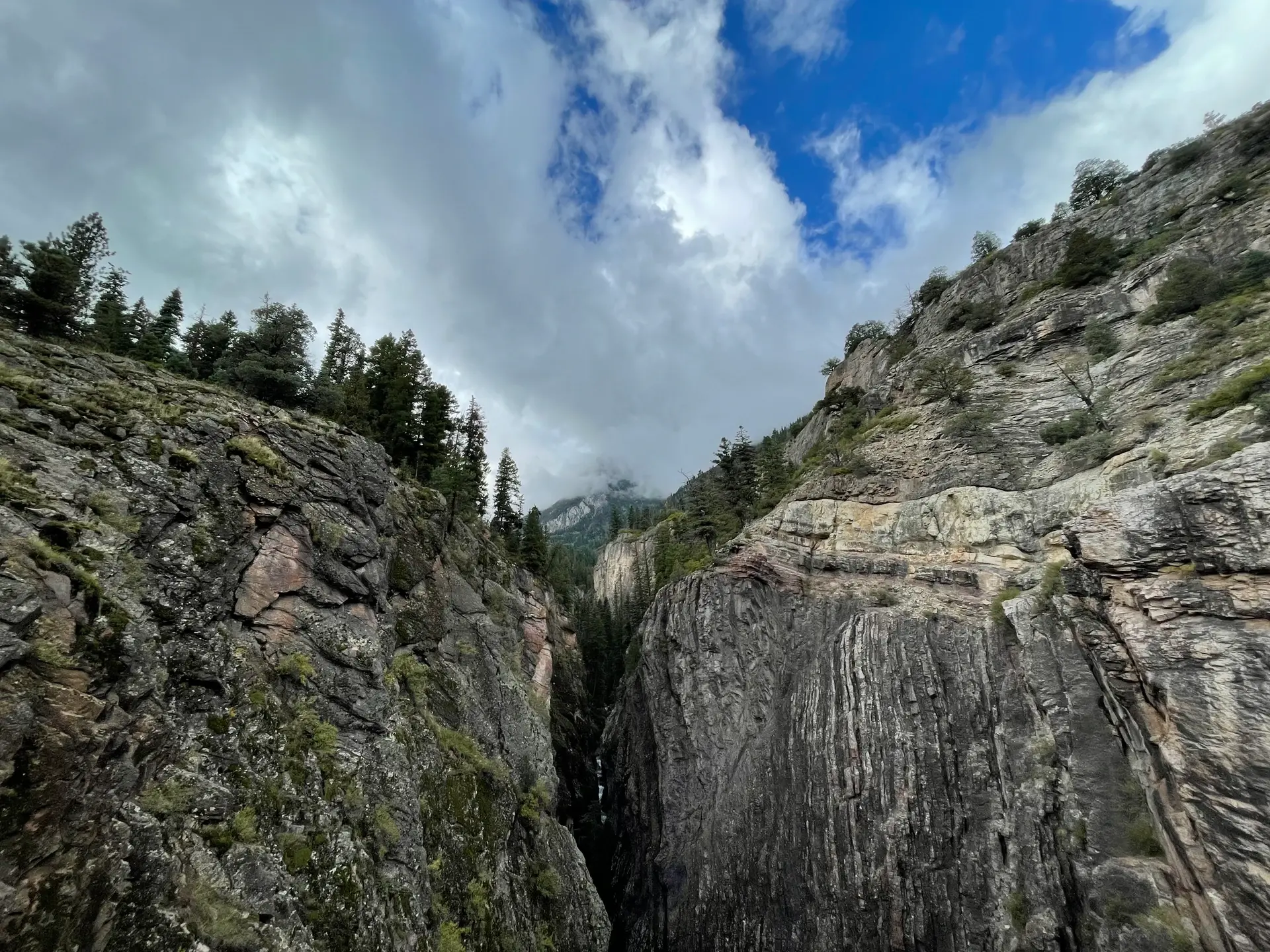 Photo: International Parks
Box Cañon Falls
City Park · Colorado, United States
- Rating
- 63
About Box Cañon Falls
Box Cañon Falls is a park owned by the City of Ouray, Colorado, at the southwest edge of town, where Canyon Creek makes its final plunge through a narrow, dark quartzite gorge before joining the Uncompahgre River. A walkway and stairs lead into the slot canyon to a viewpoint at the foot of the roaring falls, where thousands of gallons of water a minute pour through rock walls that tower nearly 100 feet above. A second trail climbs to a high footbridge spanning the canyon, with views over Ouray and the surrounding San Juan Mountains. The park has a nature center with exhibits on geology, wildlife and history, and it is best known among birders for a nesting colony of black swifts, which led the National Audubon Society to recognize the canyon as an Important Bird Area. An admission fee is charged.
Been to Box Cañon Falls? How was it?
Drag to rate. No account needed.
Photos
Add your photos1 / 7Photo: International ParksPark Information
The park's most celebrated residents are black swifts, the largest swifts that migrate to North America, which nest in a significant colony in the canyon at the falls. The birds typically arrive in early June; each female usually lays a single egg, chicks hatch after 24 to 25 days and are fed by both parents on flying insects and ballooning spiders, and young birds leave with the adults around the first frost in early September. Research on birds from this colony helped reveal that black swifts from Colorado winter in the lowland rainforest of western Brazil, more than 4,300 miles away. Other birds found around the falls include white-throated swifts, Cordilleran flycatchers, Cassin's finches and red-naped sapsuckers, and the feeding stations behind the nature center attract more species. Chipmunks are common along the trails. Black swifts are protected under the Migratory Bird Treaty Act of 1918.
The park sits where cliff faces, a rushing mountain stream and mixed conifer forest meet on the edge of Ouray, and its plant life reflects that mix of habitats. The Native Plant Loop, a short, easy walk past trees and shrubs with identification markers, introduces visitors to the local flora of the canyon and is the only trail in the park without steps. Behind the nature center a garden has been planted with a selection of native species, and wildflowers of the canyon include the American pasqueflower. Above the shaded gorge, the High Bridge and Perimeter trails climb through woodland on their way to views over the town, and several bird feeding stations in the garden make it a good place to watch the park's birds.
Box Cañon is a narrow gorge cut by Canyon Creek into hard, dark quartzite, with cliffs that rise up to about 200 feet and walls that tower nearly 100 feet over the falls themselves. The rock belongs to the Uncompahgre Formation, a Proterozoic sequence of quartzite, slate and phyllite more than 8,700 feet thick that is about 1.7 billion years old and is prominently exposed just south of Ouray. The canyon also displays an angular unconformity, where much younger sedimentary rock rests on the tilted older layers across a gap in the geologic record of roughly 1.3 billion years. Inside the slot, the falls drop into a large pothole, and the water spills into a deep pool before running through the last few hundred feet of gorge toward the Uncompahgre River. Canyon Creek itself forms upstream where Sneffels Creek and Imogene Creek join.
The park lies at about 7,800 feet in Ouray, a mountain town with a humid continental climate of warm summer days, cool nights and long, cold, snowy winters. The town receives roughly 24 inches of precipitation a year, and mid-May through late June is usually the driest stretch, while July and August bring frequent afternoon thunderstorms. Averaged across the year, daily highs are around 55°F and daily lows are near freezing, with recorded extremes from 94°F down to -16°F. The seasons also set the rhythm of the park's wildlife: black swifts arrive in early June and leave around the first frost in early September. The park's admission season runs from May into early November.
Box Cañon Falls Park is owned and operated by the City of Ouray. A historical marker in town records that the city decided in 1903 to light Box Cañon Park, and that the idea of an electric sign over the High Bridge was presented to the city council in December 1908; a lighted Box Cañon sign became a local landmark, and a 1934 newspaper item recalled vandals climbing the cliffs to reach its bulbs. The city built the metal walkway that makes the otherwise inaccessible falls reachable, and the park now includes a nature center with interpretive exhibits on geology, wildlife and history. Volunteers have helped maintain its historic routes, with the Ouray Trail Group refurbishing part of the old pipeline trail using donations and volunteer labor. The National Audubon Society's recognition of the canyon as an Important Bird Area for its black swift colony added a conservation role to the park's long history as a scenic attraction.
The main attraction is the Falls Trail, a mostly level, easy walk of about 500 feet into the canyon along a metal walkway and down a staircase to a viewpoint at the base of the falls, where the water crashes into its plunge pool between towering quartzite walls. The High Bridge Trail is a half-mile round trip that climbs about 200 feet through woodland to a footbridge spanning the canyon above the falls, with a short tunnel on its far side and views over Ouray and the peaks of the Amphitheater cirque. The short Native Plant Loop, with markers identifying trees and shrubs, is the park's only trail without steps. The High Bridge Trail also links to Ouray's Perimeter Trail, which together form a loop of about 0.9 miles and continue on through the woods around the town. Birders come to watch the black swift colony in summer.
Box Cañon Falls Park is at the southwest edge of Ouray, just off US 550 at the south end of town, and is reached by the short, unpaved Box Canyon Road. US 550 is the only paved road into Ouray, connecting it with Montrose about 40 miles to the north and, over the Million Dollar Highway and Red Mountain Pass, with Silverton to the south. The nature center houses interpretive exhibits on geology, wildlife and history and a gift shop where admission is paid; picnicking is available and no reservations are needed, but dogs are not allowed. Admission is charged, with adult rates of about $7 to $8 in recent seasons, reduced prices for children and seniors, and free entry for young children and visitors 75 and over. The park operates seasonally from May into early November, with last entry at 4:30 p.m., so it is worth checking the City of Ouray's current schedule before a visit.
The park's black swift colony is among the most closely studied in North America. Observers recorded breeding at Box Cañon every year from 1996 to 2017, and a 22-year study published in the Wilson Journal of Ornithology in 2020, the largest and longest dataset on the species' breeding, found that 77.5 percent of nest attempts succeeded but that the number of nest attempts and fledged chicks declined over the period, with no link to summer temperature, rainfall or tourist visitation. In 2009 researchers fitted black swifts at Box Cañon and nearby sites with light-level geolocators, and the data, published in 2012, gave the first evidence that this population winters in western Brazil. The species is listed as Vulnerable on the IUCN Red List, and its North American population fell by an estimated 94 percent between 1970 and 2014. The National Audubon Society recognizes the canyon as an Important Bird Area, and dogs are not allowed in the park.
Ratings
Compare with other parks ›Box Cañon Falls
Rated higher than 82% of parks on the site · strongest in Safety and Access
How rare and distinctive are the park's natural features compared with parks worldwide?
How dramatic is the landscape's scale and power? Consider sheer cliffs, deep canyons, big waterfalls, glaciers, and volcanoes.
How beautiful are the landscapes, vistas, and natural features?
How impressive and unique are the geological formations and features?
How diverse and unique is the plant life? Consider rare species and distinctive ecosystems.
How abundant and diverse is the wildlife? Consider rare species and unique animal ecosystems.
How peaceful and serene is the environment? Consider noise levels and opportunities for solitude.
How easy is it to get to the park from anywhere in the world, and to get around once you're there?
How safe is the park, region, and journey? Consider dangerous wildlife, plants, weather, crime, and political stability.
How significant are the historical and cultural features?
Location and Map
- Region
- Colorado, United States
- Coordinates
- 38.018° N, 107.678° W (show on the full map)
- Nearest city
- Ouray (1 mi)
- Nearest major city
- Grand Junction (86 mi)
- N/A
- <30
- 30s
- 40s
- 50s
- 60s
- 70s
- 80+
Park Statistics
- Entrance fee
- US$8
Visitor Comments