Mount Falcon's recorded history centers on John Brisben Walker, born in 1847, who made his fortune as owner and editor of Cosmopolitan magazine, sold it to William Randolph Hearst in 1905, and then built early steam automobiles. After that business failed, he returned to Colorado, where he had farmed since 1879, and bought several thousand acres that included the town of Morrison, Mount Morrison, Mount Falcon and the Park of Red Rocks, which he called the Garden of the Titans and which is now Red Rocks Amphitheatre. In 1909, local workers and laborers brought from Italy began his native-stone mansion on Mount Falcon, with eight fireplaces and a servants' wing. His daughter said the name came from a falcon that circled above her parents as they surveyed the site. In 1911 Walker launched a campaign for a Summer White House, a castle designed by Denver architect Jacques Benedict with 22 rooms and four towers. Schoolchildren donated dimes and the town of Morrison gave $1,000, but the money never came. In 1918 the mansion burned, supposedly from lightning, though rumors of robbery and arson persist.
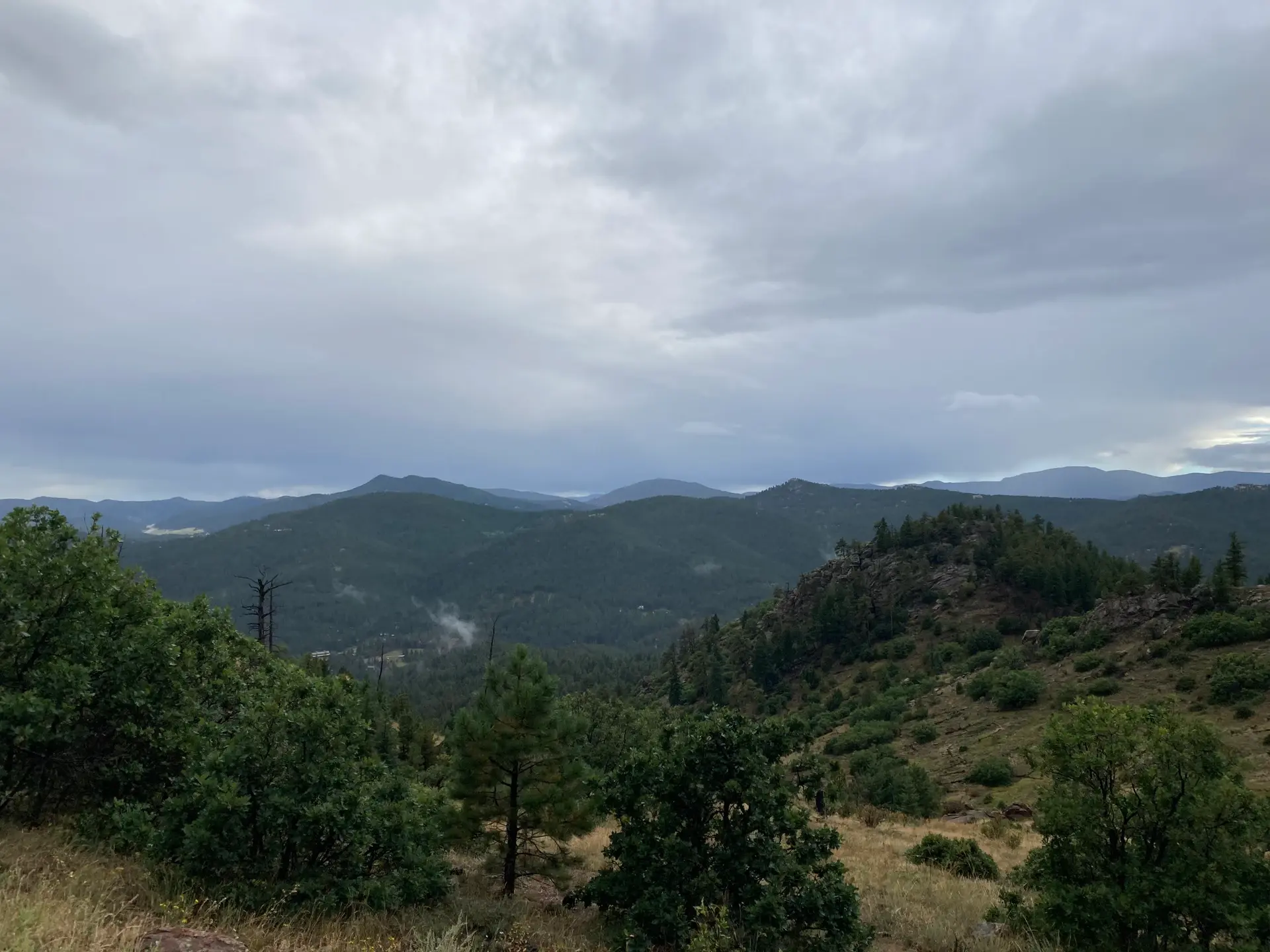 Photo: International Parks
Mount Falcon
County Park · Colorado, United States
- Rating
- 53
- Established
- 1974
- Area
- 9.1 km²
About Mount Falcon
Mount Falcon Park is a Jefferson County Open Space park of about 2,250 acres in the Front Range foothills, rising southwest of Morrison and about 15 miles west of Denver, between the canyons of Bear Creek and Turkey Creek. Its upper mesa of grassy meadows and ponderosa pine and Douglas-fir woods looks east over Red Rocks and the plains and west toward Mount Evans, now Mount Blue Sky. The park is best known for its history. It holds the stone ruins of the mansion that the publisher and promoter John Brisben Walker began in 1909, which burned in 1918, and the foundation and 1911 marble cornerstone of the Summer White House he hoped to build for U.S. presidents. About 12 miles of trails link a trailhead in Morrison with one on the upper mesa near Indian Hills. They are open to hikers, horseback riders and mountain bikers.
Been to Mount Falcon? How was it?
Drag to rate. No account needed.
Photos
Add your photosPhoto: International ParksPark Information
Mount Falcon's mix of sunny pine woodland, shaded conifer forest and open meadow supports the wildlife typical of the Front Range montane zone. Mule deer are common, and small herds of elk are sometimes seen along the entry road. Abert's squirrels, tassel-eared squirrels closely tied to ponderosa pine, live in the park alongside Colorado chipmunks and golden-mantled ground squirrels. Black bears use the forested northwest part of the park, which the county has closed to the public partly to protect wildlife habitat. Birdlife is varied. Steller's jays, black-billed magpies, American crows and northern flickers are the most conspicuous, while pygmy nuthatches and American robins are among the most numerous residents. Observers have also recorded western and mountain bluebirds, Townsend's solitaires, hairy woodpeckers, pine siskins, mountain chickadees, red-breasted nuthatches and the gray-headed form of the dark-eyed junco. Visitors are asked to stay on designated trails, because off-trail travel fragments habitat and disturbs wildlife.
The park's vegetation follows the pattern of the Colorado foothills, where aspect decides what grows. Open ponderosa pine woodland covers the sunny, south-facing slopes, forming the park-like stands of widely spaced trees that give the montane zone its character. On cooler north-facing slopes, Douglas-fir and Colorado blue spruce take over and the forest closes in. Between the wooded slopes, the upper mesa opens into grassy meadows, crossed by the aptly named Meadow Trail, that fill with wildflowers in spring and summer. The most valuable plant communities lie in the northwest of the park. There, biological surveys carried out over several decades have documented rare plants, sensitive habitat and an old-growth Douglas-fir forest community that is uncommon in Colorado. To protect it, Jefferson County Parks and Open Space designated about 494 acres as a Resource Protection Area in 2026. Visitor-created trails and off-trail travel damage this vegetation and help spread invasive plants.
Mount Falcon is built of some of the oldest rock in Colorado. A 1968 U.S. Geological Survey study of the crystalline rocks west of Morrison describes the bedrock as Precambrian metasedimentary gneisses of the kind grouped as the Idaho Springs Formation. These are mainly microcline gneiss, biotite gneiss and hornblende gneiss, which were metamorphosed to high grade and folded at least twice before the Rocky Mountains existed. South of Bear Creek the microcline gneiss is threaded with layers of granitic material. At Mount Falcon itself the rock contains so much of it that it resembles a well-foliated granodiorite. The same survey mapped a small body of quartz diorite north of the Falcon Castle ruins and sampled migmatitic gneiss beside the ruins and on the mountain's southwest slope. Just east of the park, the basement gives way to steeply tilted sedimentary layers that were folded during the Laramide mountain-building episode.
Mount Falcon has the dry, sunny climate of the Colorado Front Range foothills, but conditions shift over the roughly 2,000 feet of elevation between the Morrison trailhead and the upper mesa, where the summit knoll reaches 7,851 feet. Winter brings cold and periodic snow. Snow lingers on the shaded north-facing slopes of Douglas-fir and melts sooner on the exposed south-facing slopes of pine and grass. Spring thaws leave the trails soft, and Jefferson County Parks and Open Space closes trails when mud would cause damage, posting each closure on its Alerts and Closures page. In summer, afternoon thunderstorms often build over the mountains, and lightning is a real hazard on the open ridges and at the summit tower. A lightning strike is the usual explanation for the 1918 fire that destroyed Walker's mansion. The county links National Weather Service forecasts from the park's page.
Jefferson County Open Space acquired the original 1,490 acres of the Mount Falcon property from a private owner in 1974. A county history publication gives the purchase price as $1.3 million. It was one of the early acquisitions of the county's open space program. PLAN Jeffco, the citizens' group that has campaigned for public lands in Jefferson County since 1972, profiles Mount Falcon among the county's parks. Another 117 acres were added in 2009 with open space bond funds, and the park now covers about 2,250 acres with roughly 12 miles of trail. The World Database on Protected Areas records it as county land designated in 1974 and assigns it IUCN Category V, protected landscape. The park preserves part of the roughly 4,000 acres that Walker once assembled in the area, land that now benefits both Denver Mountain Parks and Jefferson County Open Space. The ruins of his home and his Summer White House were left standing as historic sites. A former private summer cabin on the mesa was rebuilt as the Eagle Eye picnic shelter.
The Castle Trail is the park's backbone. From the Morrison trailhead it climbs about 2,000 feet up the east face of the mountain, a steep three-mile ascent to the upper mesa with widening views over Red Rocks, the hogbacks and Denver, which seems to float like an island on the plains. On the mesa, a short spur off the Castle Trail about three-quarters of a mile from the west trailhead reaches the ruins of Walker's home. Its stone walls, window frames and fireplaces stand open to the sky. Farther along, the Walker's Dream spur leads to the foundation of the Summer White House and its 1911 marble cornerstone at the edge of a cliff. The Tower Trail climbs to a wooden lookout tower on the rocky summit knoll at 7,851 feet, with views reaching Mount Evans, now Mount Blue Sky. It passes the Eagle Eye Shelter, a picnic shelter rebuilt from the Kirchhof family's summer cabin (1933 to 1972). The Meadow and Parmalee trails loop through the meadows and woods. The 1.7-mile Turkey Trot Trail is reserved for hikers and horseback riders.
Mount Falcon has two trailheads, and entry and parking are free. The Morrison Trailhead, at 3852 Vine Street in Morrison, is reached from C-470 by way of U.S. 285 and Colorado 8 into Morrison, then Forest Avenue and Vine Street. When its lot is full, visitors park along Vine Street. The Mount Falcon West Trailhead, at 21074 Mount Falcon Road near Indian Hills, sits on the upper mesa, where short, gentle walks lead to the ruins, the tower and the shelter. Its lot has three accessible parking spaces. Both trailheads have restrooms but no drinking water, so visitors should carry their own. Like most Jefferson County Open Space parks, Mount Falcon is open from one hour before sunrise to one hour after sunset. Dogs must stay on a leash no longer than 10 feet, and all trails except the Turkey Trot are shared by hikers, cyclists and horseback riders. The lots fill early on weekends. The county is piloting cameras at the Morrison Trailhead to count visitors by activity and measure parking use, without recording faces or license plates.
Mount Falcon is managed by Jefferson County Parks and Open Space, which tries to balance heavy Front Range recreation with protection of the park's natural and historic resources. The largest recent step came in 2026, when about 494 acres in the northwest of the park were designated a Resource Protection Area. That ground holds rare plants, sensitive habitat, an old-growth Douglas-fir community uncommon in Colorado, and habitat for wildlife including black bears. It is now closed to the public except for approved management, research, education and stewardship. The county plans to restore visitor-created trails, add signs and boundary measures, maintain a ranger presence and monitor the area's condition, while keeping every designated trail open. The decision follows the county's 2024 resident survey, in which 48 percent of residents favored an equal balance between protection and recreation and another 33 percent wanted more emphasis on protection. The 2026 to 2030 Conservation Greenprint makes ecosystem health a priority. Visitor counts from the Morrison Trailhead camera pilot feed planning for future improvements.
Ratings
Compare with other parks ›Mount Falcon
Rated higher than 48% of parks on the site · strongest in Access and Safety
How rare and distinctive are the park's natural features compared with parks worldwide?
How dramatic is the landscape's scale and power? Consider sheer cliffs, deep canyons, big waterfalls, glaciers, and volcanoes.
How beautiful are the landscapes, vistas, and natural features?
How impressive and unique are the geological formations and features?
How diverse and unique is the plant life? Consider rare species and distinctive ecosystems.
How abundant and diverse is the wildlife? Consider rare species and unique animal ecosystems.
How peaceful and serene is the environment? Consider noise levels and opportunities for solitude.
How easy is it to get to the park from anywhere in the world, and to get around once you're there?
How safe is the park, region, and journey? Consider dangerous wildlife, plants, weather, crime, and political stability.
How significant are the historical and cultural features?
Location and Map
- Region
- Colorado, United States
- Coordinates
- 39.652° N, 105.222° W (show on the full map)
- Nearest city
- Morrison (2 mi)
- Nearest major city
- Denver (14 mi)
- N/A
- <30
- 30s
- 40s
- 50s
- 60s
- 70s
- 80+
Park Statistics
- Established
- 1974
- Total area
- 9.1 km²
- Entrance fee
- Free Entry
Visitor Comments