Buttermilk Falls
United States, New York
About Buttermilk Falls
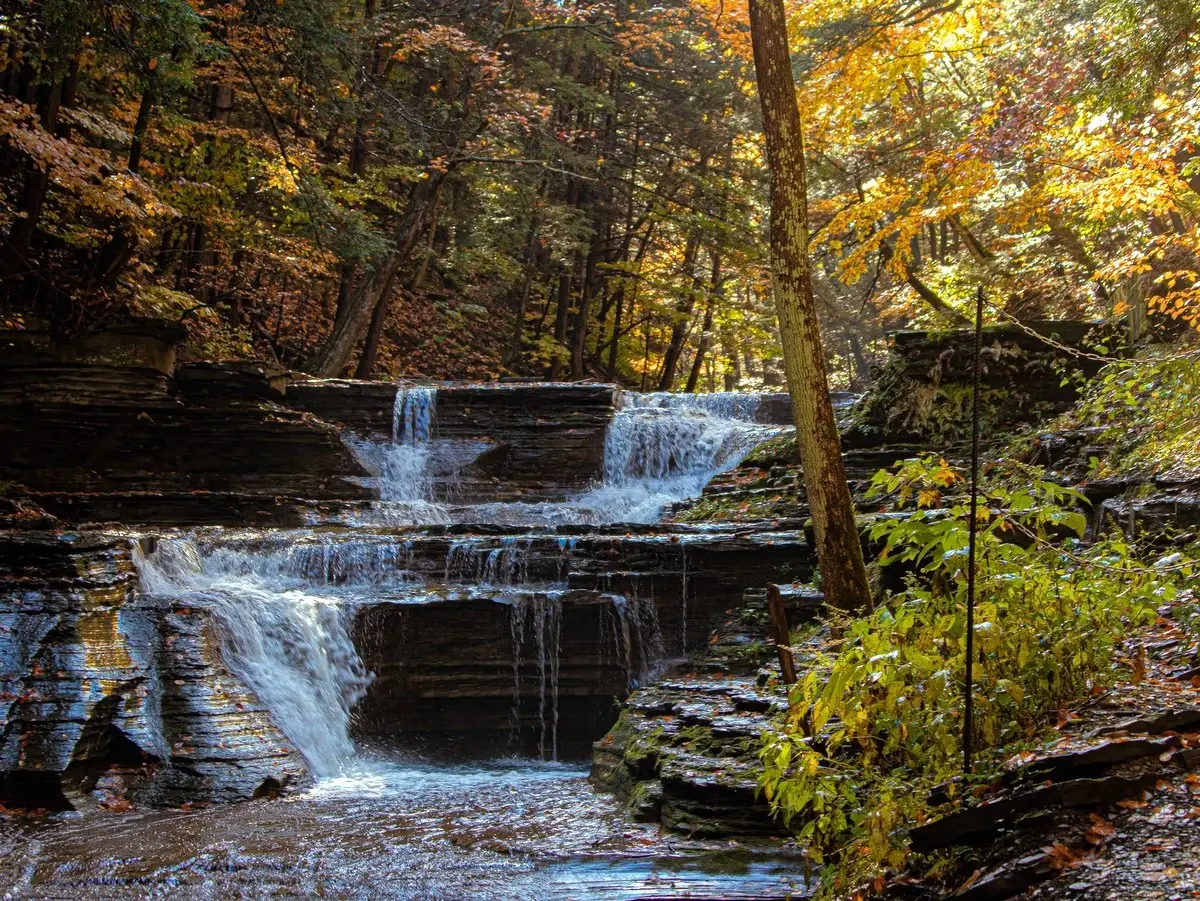
Buttermilk Falls State Park is an 811-acre state park southwest of Ithaca, New York, in the Finger Lakes region.[1] It takes its name from the foaming cascade formed by Buttermilk Creek as it flows down the steep valley side toward Cayuga Lake.[2] The park has 10 waterfalls, with Buttermilk Falls the main attraction, and also offers a swimming area, cabins, a campground, hiking, fishing and picnic pavilions.[1] The upper park has a small lake, hiking trails along the gorge and rim, picnic areas and playing fields, while the lower park has the campground, a natural pool and playing fields.[2] The park is operated by the New York State Office of Parks, Recreation and Historic Preservation.[1]
Wildlife Ecosystems
The New York State Department of Environmental Conservation lists gray and red squirrels, chipmunks, cottontail rabbits, skunks, raccoons, opossum and red foxes among the wildlife to watch, along with little brown and big brown bats, flying squirrels and coyotes at dusk.[3] Birds include ruffed grouse, turkey, pileated woodpeckers, owls, great blue heron, and sharp-shinned, red-tailed and broad-winged hawks, with many songbirds especially during the mid-May migratory peak.[3] Woodchucks, muskrats and beavers are also listed, and the best places to watch are the gorge, the stream, the potholes and the wetland and forest.[3]
Flora Ecosystems
The park lies in the Finger Lakes Uplands and Gorges ecoregion on the northern edge of the Northern Allegheny Plateau.[4] In the main gorge, the rich, mesic woods are dominated by eastern hemlock, yellow birch, red oak, basswood and white ash, with hop hornbeam and mountain maple in the understory and witch hazel the most common shrub.[5] Damp ledges along the creek are draped with bulblet bladder fern, clearweed, wood-nettle, mosses and liverworts.[5] A survey of the gorge's vascular plants was carried out between April 2017 and May 2022.[6] In the lower park, Larch Meadows is a wetland through which a nature trail winds.[2]
Geology
The rock in the park is primarily Devonian shale and sandstone, laid down in horizontal layers that erode into flat slabs and angular edges.[1] The gorge and waterfalls formed since the last ice age as Buttermilk Creek eroded back from the head of a hanging valley, leaving potholes and a stack called Pinnacle Rock.[1] The park's main gorge, created during the last glaciation, is cut through shale and sandstone bedrock by Buttermilk Creek, and an older, narrower gorge is credited to the earlier glaciation.[6] The wider Finger Lakes landscape was carved by glaciers that left deep, steep-sided valleys now filled by long, narrow lakes such as Cayuga.[4]
Climate and Weather
Ithaca, the nearest city, has average highs of about 32 degrees Fahrenheit in January and 81 degrees in July, with average lows of about 16 degrees in January and 58 degrees in July.[7] The park is open year-round from dawn to dusk.[2] Camping runs from May 15 to October 11 in 2026, and swimming is seasonal: in 2026 it was scheduled to begin July 3 and likely close by mid-August, subject to lifeguard staffing and water quality.[2] Bow hunting for deer is permitted in season.[2]
Human History
Native Americans lived in the Ithaca area for thousands of years, and when Europeans arrived the area was controlled by the Cayuga, one of the five nations of the Haudenosaunee Confederacy.[7] Ithaca was settled by Europeans in 1794 and formally established in 1821.[7] The falls were named for their frothy appearance, a naming described in an 1866 account of the scenery of Ithaca and the head waters of Cayuga Lake.[1] The land that became the park came from Robert and Laura Treman in 1924.[1]
Park History
The park's original 164 acres were given to New York State in 1924 by Robert and Laura Treman, and the park later grew to its current 811 acres through further state acquisitions.[1] Additional parcels were added to protect the watershed of Buttermilk Creek, which runs about five miles from its origin at Jennings Pond in the town of Danby.[6] Robert and Laura Treman also gave land that became Robert H. Treman State Park, and event shelter reservations for the area are handled through that park's office.[1][2] The park is open year-round, dawn to dusk, and a vehicle entry fee is collected from April through November.[2]
Major Trails and Attractions
The Gorge Trail follows Buttermilk Creek as it cascades, dropping about 600 feet along the trail, and is paired with the Rim Trail on the other side of the creek for a loop of about 1.5 miles.[1] The Bear Trail continues up the creek to Lake Treman Falls and Lake Treman, and the trail to and around the lake is another 1.5 miles.[1] The Larch Trail circles a marsh near the main parking area and is about 1 mile long, and a spur of the Finger Lakes Trail starts at the far end of the lake.[1] Pinnacle Rock and the potholes along the creek are other features.[1] A natural swimming pool at the base of the falls offers seasonal swimming.[2]
Visitor Facilities and Travel
The park is at 106 East Buttermilk Falls Road (off Route 13 South) in Ithaca, NY 14850, with the main entrance serving the campground, gorge trails, waterfalls and swimming.[2] The upper entrance gives access to the day use area, Pinnacle Rock, Lake Treman and the gorge trails.[2] A vehicle entry fee of $10 for cars is collected daily from April 1 to November 30, and campsites cost $17 to $21 per night.[2] Amenities include cabins, campsites, showers, grills, a playground, playing fields and one pavilion that holds 65 people.[2] A maximum of two pets are allowed in campsites and day use areas, and pets are not permitted in buildings or guarded beaches.[2]
Conservation and Sustainability
The park's later additions were acquired to protect the watershed of Buttermilk Creek, which runs from Jennings Pond in Danby down to Cayuga Lake.[6] The park's gorge has been the subject of a five-year survey of its vascular plants.[6] Visitors are asked to stay on trails and check the park office for the current status of trails and swimming, since closures occur because of water quality, weather and lifeguard availability.[2]
Photos
1 photo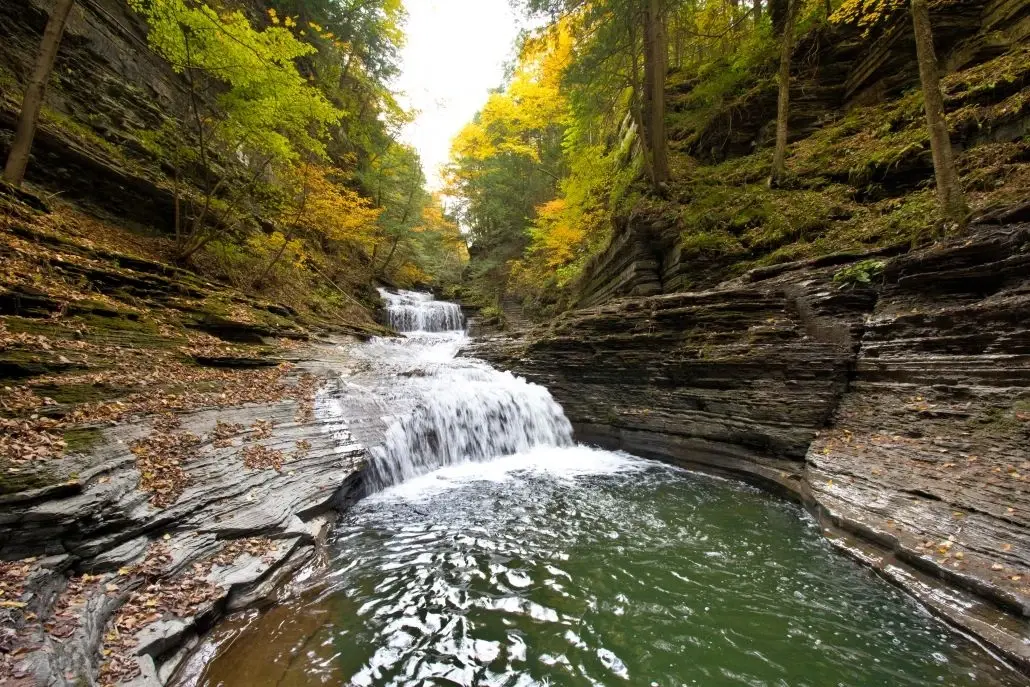
More Parks in New York
Top Rated in United States: State Park
Sources
- en.wikipedia.org/wiki/Buttermilk_Falls_State_Park (opens in a new tab)
- parks.ny.gov/parks/buttermilkfalls/details.aspx (opens in a new tab)
- dec.ny.gov/things-to-do/watchable-wildlife/sites/buttermilk-falls-state-park (opens in a new tab)
- en.wikipedia.org/wiki/Finger_Lakes (opens in a new tab)
- flnps.org/buttermilk/documents/ecology/ecology_gorge_highlands_wet.htm (opens in a new tab)
- flnps.org/buttermilk/documents/overview.htm (opens in a new tab)
- en.wikipedia.org/wiki/Ithaca,_New_York (opens in a new tab)