Glenmore is the site of the remains of a township called Beglan, thought to date from about 1740. The Duke of Gordon, who owned Glenmore, offered the chance to run a timber business in the glen. The Glenmore Company bought the timber rights in 1784 and set up a shipyard at the mouth of the River Spey. Logs were stored on Loch Morlich until there was enough water to float them down the river to the shipyard. The company built 47 large ships and completed its contract in 1805, and one of them was named Glenmore after the source of its timber. During the Second World War, Norwegian resistance fighters who became known as Kompani Linge trained in the Glenmore area as part of the Special Operations Executive, using the forests and Loch Morlich shores to prepare for raids on Nazi-occupied Norway. A memorial to these fighters stands just outside the Glenmore Visitor Centre.[14]
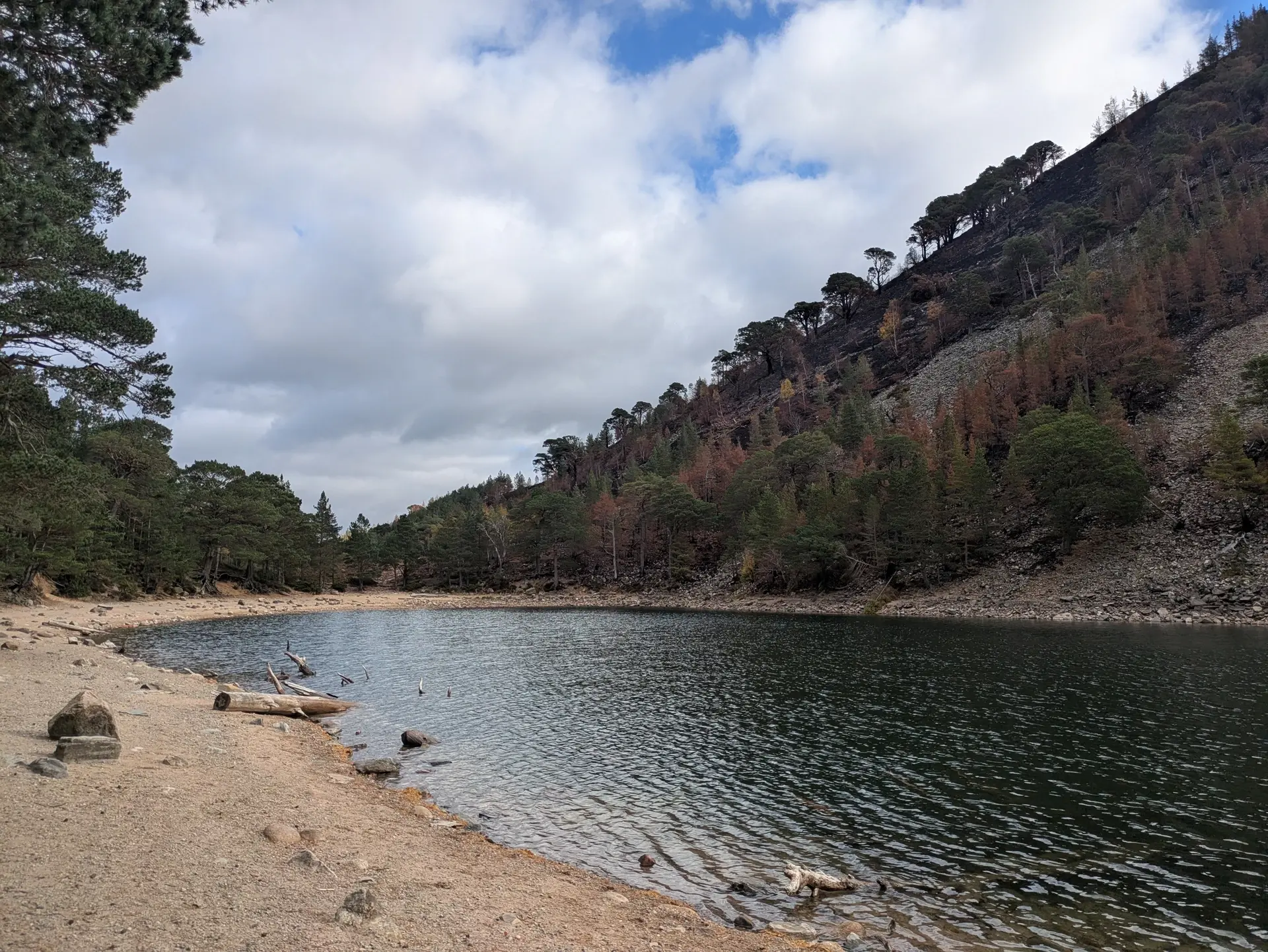 Photo: Zachary Matchinski
Glenmore
National Nature Reserve · Scotland, United Kingdom
- Rating
- 60
- Established
- 2007
- Area
- 21 km²
Find another park
Search every park by name, state, country or type
About Glenmore
Glenmore National Nature Reserve lies in the Highland council area and was designated on 6 September 2007.[1] The reserve forms about 21.1 square kilometres of Glenmore Forest Park, which Forestry and Land Scotland owns and manages within the Cairngorms National Park.[2] Glenmore Forest lies on the north-west slopes of Cairn Gorm and is predominantly a Caledonian pine forest. It is an important and linking component of the chain of native pinewoods stretching from Glenfeshie to Abernethy, which together form the largest expanse of native pinewood remaining in the UK.[3] Glenmore Forest Park is one of the best places to see Scottish crossbill and crested tit.[4] The Ryvoan Trail from the Glenmore Visitor Centre leads to An Lochan Uaine, the Green Lochan.[5]
Been to Glenmore? How was it?
Drag to rate. No account needed.
Photos
Add your photos1 / 7Photo: Zachary MatchinskiPark Information
Glenmore Forest Site of Special Scientific Interest is notified for its populations of Scottish crossbill, capercaillie and narrow-headed ant, all of which are associated with pinewood habitats.[3] The Scottish crossbill is the UK's only endemic bird species, found nowhere else in the world.[6] The western capercaillie is the largest of all extant grouse species.[7] Capercaillie numbers are critically low, with only 532 left in Scotland, and the Cairngorms National Park is the last stronghold for them in the UK.[8] The Capercaillie Emergency Plan 2025 to 2030, launched by the Cairngorms National Park Authority and NatureScot, seeks to reduce human disturbance from activities like mountain biking and dog walking.[9] Forestry and Land Scotland describes the forest park as one of the best places to see Scottish crossbill and crested tit, small birds that rely on healthy Scots pine forests. Red squirrels are usually seen near the Glenmore Visitor Centre car park, and visitors can watch for ospreys fishing at Loch Morlich. The wet, boggy habitats of the park suit dragonflies and damselflies, which can be seen along the trails from Hayfield car park in summer.[4] Red deer are among the notable species of the forest park.[2]
Around 400 hectares of Glenmore Forest is self-sown native pinewood, together with a similar area of planted Scots pine of local origin that is now managed for conservation. Much of the native forest was felled in the late 19th and early 20th centuries, but substantial areas of semi-natural woodland have survived. Small areas of juniper scrub occur, and alder, willows and Scots pine form bog woodland in wetter areas. At lower altitudes scattered regeneration of birch, willow, rowan and Scots pine is expanding onto areas of open heath, while at higher elevations a natural tree line is developing. The site is notified for a vascular plant assemblage containing many species associated with native pinewoods, including one-flowered wintergreen, twinflower, small cranberry and intermediate wintergreen.[3]
Glenmore Forest is predominantly Caledonian pine forest growing over a variety of glacial and fluvial-glacial deposits and landforms. These include extensive Quaternary deposits and landforms produced by the melting of the last Scottish ice sheet, such as eskers, kames, terraces, meltwater channels and kettle holes. The features provide important evidence for reconstructing the pattern of deglaciation at the end of the last Ice Age and the associated climate changes.[3] The Cairngorms rise from an eroded plateau built on an exposed granite pluton.[10] An Lochan Uaine takes its name from the Gaelic for a green tarn and lies about 3.2 km north-east of Loch Morlich, at the foot of the eastern flanks of Creag nan Gall (622 m).[11]
In winter, the trails around Glenmore can be followed on cross-country skis or on a snowshoe trek.[12] Fires and barbecues are banned in the Cairngorms National Park from 1 April to 30 September under a fire byelaw, and breaking it could result in a fine of up to 500 pounds.[13] Parts of Glenmore Forest Park were affected by a major wildfire in the summer of 2026.[2] Visitors are advised to stay on open forest roads and waymarked trails in the affected area.[12]
Glenmore was declared a forest park in 1948.[2] The land was purchased from the Duke of Gordon in 1923, and the Forestry Commission replanted it.[15] Forestry and Land Scotland, formed on 1 April 2019, took over some of the responsibilities of Forestry Commission Scotland.[16] Glenmore Forest was first notified as a Site of Special Scientific Interest on 27 September 1996, and the notification was reviewed on 30 October 2008. The site is part of the Cairngorms Special Area of Conservation and the Cairngorms Special Protection Area.[3] The Cairngorms National Park was established in 2003.[17] Glenmore Forest Park lies at the heart of the national park.[12] The National Nature Reserve was designated on 6 September 2007.[1] The Aviemore and Glenmore Community Trust took over the Glenmore Visitor Centre from Forestry and Land Scotland in November 2024.[18]
The Ryvoan Trail starts at the Glenmore Visitor Centre and leads to An Lochan Uaine, the Green Lochan. The lower section is a broad, firm forest road suited to cycling and buggies, and the upper section crosses the hillside past ferns and rocks. Either section can be walked out and back, or the two can be combined into a circuit. Meall a' Bhuachaille can be climbed directly from the Glenmore Visitor Centre, and the path climbs steadily to the summit at 810 metres. The Beach Trail is an easy walk through mixed forest, passing the Allt Mor burn and the golden sands of Loch Morlich. The Loch Morlich Trail is a two-hour circuit with fine views of the mountains.[5] Loch Morlich Beach offers watersports and walking at the highest beach in Britain. In winter the surrounding trails can be followed on cross-country skis or on a snowshoe trek.[12]
The community-owned Glenmore Visitor Centre is a good starting point for a visit to Glenmore.[12] The Aviemore and Glenmore Community Trust took over the centre from Forestry and Land Scotland in November 2024, and its café has quickly become a space the community uses and enjoys.[18] The Aviemore Adventurer 30 bus runs seven days a week between Aviemore and Cairngorm Mountain. Aviemore is on the Highland main line, served by buses and several trains.[19] Charge parking is available at Loch Morlich Beach, Hayfield and Allt Mor, and Loch Morlich Beach has toilets and accessible toilets. Motorhomes can park overnight in selected forest car parks as part of the Forestry and Land Scotland motorhome scheme. Fires and barbecues are banned in the Cairngorms National Park from 1 April to 30 September.[13] After the wildfire, visitors are advised to stay on open forest roads and waymarked trails in the affected area.[12]
Forestry and Land Scotland manages Glenmore for timber while working to restore native species as much as possible.[4] Around 500 hectares of non-native conifers have been felled over the past 30 years, and deer control and natural regeneration are helping to expand the native Scots pine forest. Forestry and Land Scotland estimates that the remaining conifer removal will take another 15 years.[15] The planted Scots pine of local origin on the site is now being managed for conservation.[3] Forestry and Land Scotland is a partner in Cairngorms Connect, alongside Wildland Ltd, RSPB Scotland and NatureScot, which works toward a 200-year vision to improve habitats, species and ecological processes across the Cairngorms National Park.[15] The Capercaillie Emergency Plan lists Scottish Forestry and Forestry and Land Scotland as partners.[9]
Ratings
Compare with other parks ›Glenmore
Rated higher than 73% of parks on the site · strongest in Safety and Access
How rare and distinctive are the park's natural features compared with parks worldwide?
How dramatic is the landscape's scale and power? Consider sheer cliffs, deep canyons, big waterfalls, glaciers, and volcanoes.
How beautiful are the landscapes, vistas, and natural features?
How impressive and unique are the geological formations and features?
How diverse and unique is the plant life? Consider rare species and distinctive ecosystems.
How abundant and diverse is the wildlife? Consider rare species and unique animal ecosystems.
How peaceful and serene is the environment? Consider noise levels and opportunities for solitude.
How easy is it to get to the park from anywhere in the world, and to get around once you're there?
How safe is the park, region, and journey? Consider dangerous wildlife, plants, weather, crime, and political stability.
How significant are the historical and cultural features?
Location and Map
- Region
- Scotland, United Kingdom
- Coordinates
- 57.155° N, 3.678° W (show on the full map)
- N/A
- <30
- 30s
- 40s
- 50s
- 60s
- 70s
- 80+
Park Statistics
- Established
- September 6, 2007
- Total area
- 21 km²
- Entrance fee
- Free Entry
Nearby and Similar Parks
Nearest
Parks like Glenmore
Sources
Show all 19 sources
- sitelink-api.nature.scot/sitelink-api/v1/sites/10098/ (opens in a new tab)
- en.wikipedia.org/wiki/Glenmore_Forest_Park (opens in a new tab)
- nature.scot/sites/default/files/site-special-scientific-interest/1665/sssi-cita… (opens in a new tab)
- forestryandland.gov.scot/visit/forest-parks/glenmore-forest-park/wildlife-in-gl… (opens in a new tab)
- forestryandland.gov.scot/visit/forest-parks/glenmore-forest-park/trails-in-glen… (opens in a new tab)
- rspb.org.uk/birds-and-wildlife/scottish-crossbill (opens in a new tab)
- en.wikipedia.org/wiki/Western_capercaillie (opens in a new tab)
- cairngorms.co.uk/caring-future/cairngorms-nature/capercaillie/ (opens in a new tab)
- cairngorms.co.uk/our-work/capercaillie-emergency-plan-2025-2030 (opens in a new tab)
- en.wikipedia.org/wiki/Cairngorms (opens in a new tab)
- en.wikipedia.org/wiki/An_Lochan_Uaine (opens in a new tab)
- forestryandland.gov.scot/visit/forest-parks/glenmore-forest-park (opens in a new tab)
- forestryandland.gov.scot/visit/forest-parks/glenmore-forest-park/glenmore (opens in a new tab)
- forestryandland.gov.scot/visit/forest-parks/glenmore-forest-park/heritage-in-gl… (opens in a new tab)
- cairngormsconnect.org.uk/news/glenmore-centenary (opens in a new tab)
- en.wikipedia.org/wiki/Forestry_and_Land_Scotland (opens in a new tab)
- en.wikipedia.org/wiki/Cairngorms_National_Park (opens in a new tab)
- hie.co.uk/news-and-blogs/news/2025/april/17/visitor-centre-in-aviemore-transfor… (opens in a new tab)
- cairngormmountain.co.uk/getting-here/ (opens in a new tab)
Spotted something wrong or out of date? Report an issue
Visitor Comments