Bardia
Nepal, Lumbini
About Bardia
Bardia National Park covers 968 km² in the Terai of Bardiya District, Lumbini Province, and is described as the largest and most undisturbed national park in the Terai. It was gazetted in 1988 as Royal Bardia National Park, an IUCN Category II park, and adjoins the eastern bank of the Karnali River, with the Babai River bisecting it[1].
Wildlife Ecosystems
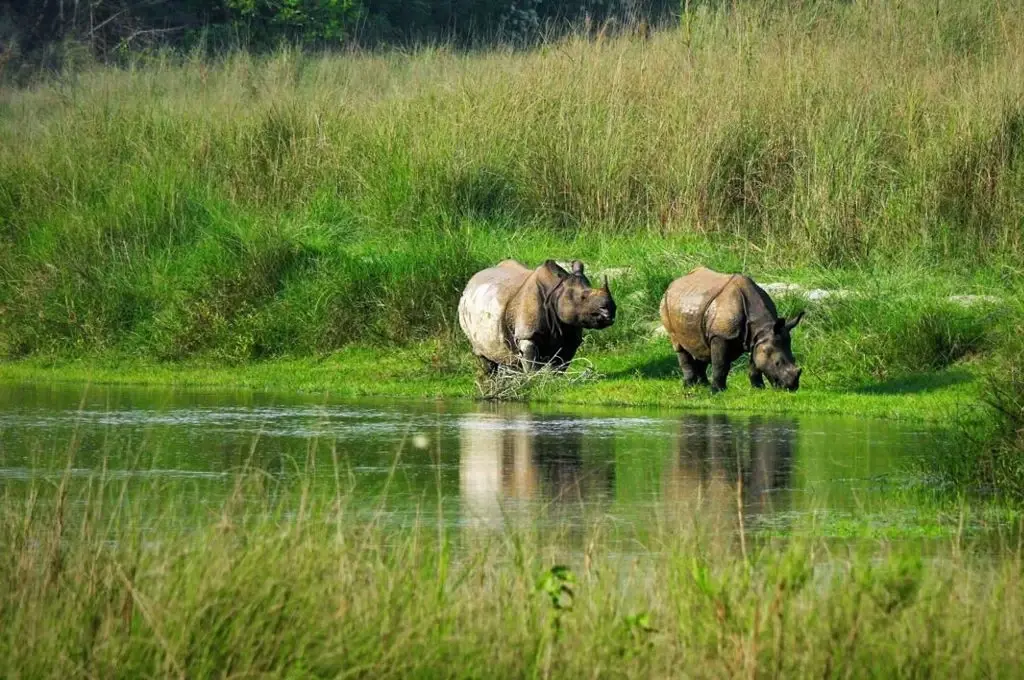
At least 53 mammal species live here, including Indian rhinoceros, Indian elephant, Bengal tiger, barasingha and the Gangetic dolphin, and 407 bird species include Bengal florican, white-rumped vulture and sarus crane. Rhinos were translocated from Chitwan from 1986 (58 by 2000) and numbered 29 by 2015. The Karnali-Babai system holds 125 fish species, a small gharial population and mugger crocodiles[1].
Flora Ecosystems
About 70% of the park is forest, with the rest grassland, savannah and riverine forest. The flora list has 839 recorded species, 173 of them vascular plants[1].
Geology
The park's northern limit is the crest of the Siwalik Hills, and the Karnali and Babai rivers shape the lowland below. The western boundary follows the Geruwa, a branch of the Karnali[1].
Climate and Weather
Bardia lies in the subtropical Terai of western Nepal, in a landscape of alluvial grasslands and moist deciduous forest[1].
Human History
Nepal ceded the region to the East India Company under the Sugauli Treaty in 1815 and regained it in 1860. About 1,500 people were resettled from the Babai Valley when it was added to the reserve, and the abandoned farmland regrew into wildlife habitat[1].
Park History
The area became a Royal Hunting Reserve of 368 km² in 1969, the Royal Karnali Wildlife Reserve in 1976 and the Royal Bardia Wildlife Reserve in 1982, extended to the Babai Valley in 1984. It was gazetted as a national park in 1988[1].
Major Trails and Attractions
The Karnali and Babai rivers are the park's main waterways and the place to look for Gangetic dolphins, while the Babai Valley, added to the reserve in 1984, is the park's largest regrown wilderness area[1].
Visitor Facilities and Travel
The Nepalgunj-Surkhet highway partly forms the southern boundary and cuts through the park[1].
Conservation and Sustainability
With neighbouring Banke National Park, Bardia forms a 1,437 km² Tiger Conservation Unit. Rhinos declined sharply after 2006 and disappeared from the Babai Valley by 2007 and 2008, then recovered to 29 by 2015 on better security. In 2021 four tigers killed ten people, and three were captured and moved to rescue centres[1].
Photos
1 photo