Colonel Denning
United States, Pennsylvania
About Colonel Denning
Colonel Denning State Park is a 273-acre park nestled in a narrow valley at the foot of Blue Mountain in Cumberland County, Pennsylvania. The park is named for William Denning, a colonel in the Pennsylvania militia during the American Revolution who operated an iron furnace in the area. A 3.5-acre lake, surrounded by steep mountain slopes, serves as the park's centerpiece for swimming and fishing. Colonel Denning is a gateway to the Tuscarora Trail and the broader Appalachian ridge system, offering both gentle lakeside recreation and access to strenuous mountain hiking on the adjacent Tuscarora State Forest.
Wildlife Ecosystems
The park's location in a mountain valley creates a funnel for wildlife moving between the ridgetop and the valley floor. White-tailed deer, black bears, and wild turkeys are common visitors, and the park's small lake supports stocked trout and panfish. Timber rattlesnakes and copperheads inhabit the rocky, south-facing slopes of Blue Mountain above the park. The forest supports breeding populations of wood thrushes, scarlet tanagers, and various warblers, while raptors including broad-winged hawks and sharp-shinned hawks migrate along the Blue Mountain ridge in fall. The lake and its surrounding wetlands attract great blue herons, wood ducks, and spring peepers.
Flora Ecosystems
The park's valley floor supports mesic hardwood forest with tulip poplar, red maple, sugar maple, and white ash, while the steeper mountain slopes are dominated by oak-hickory forest with chestnut oak as the principal species on thin, rocky soils. Eastern hemlock and white pine shade the ravines and stream corridors. Mountain laurel and rhododendron form dense understory thickets on the mountain slopes and bloom spectacularly in June. The small lake is bordered by wetland vegetation including cattails, sedges, and buttonbush. Wildflowers including lady's slipper orchid, trillium, and jack-in-the-pulpit bloom on the forest floor in spring.
Geology
Colonel Denning State Park occupies a narrow valley at the base of Blue Mountain, one of the principal ridges of the Ridge and Valley Province of the Appalachians. Blue Mountain is an anticline composed of erosion-resistant Silurian-age Tuscarora sandstone, which forms the hard ridge crest. The valley floor is underlain by softer shales and limestones that have eroded more readily. The park's small lake occupies a low point in the valley where Doubling Gap Run has been dammed. The surrounding landscape displays the classic parallel ridge and valley topography created by the differential erosion of folded sedimentary layers — a hallmark of central Pennsylvania's geology.
Climate and Weather
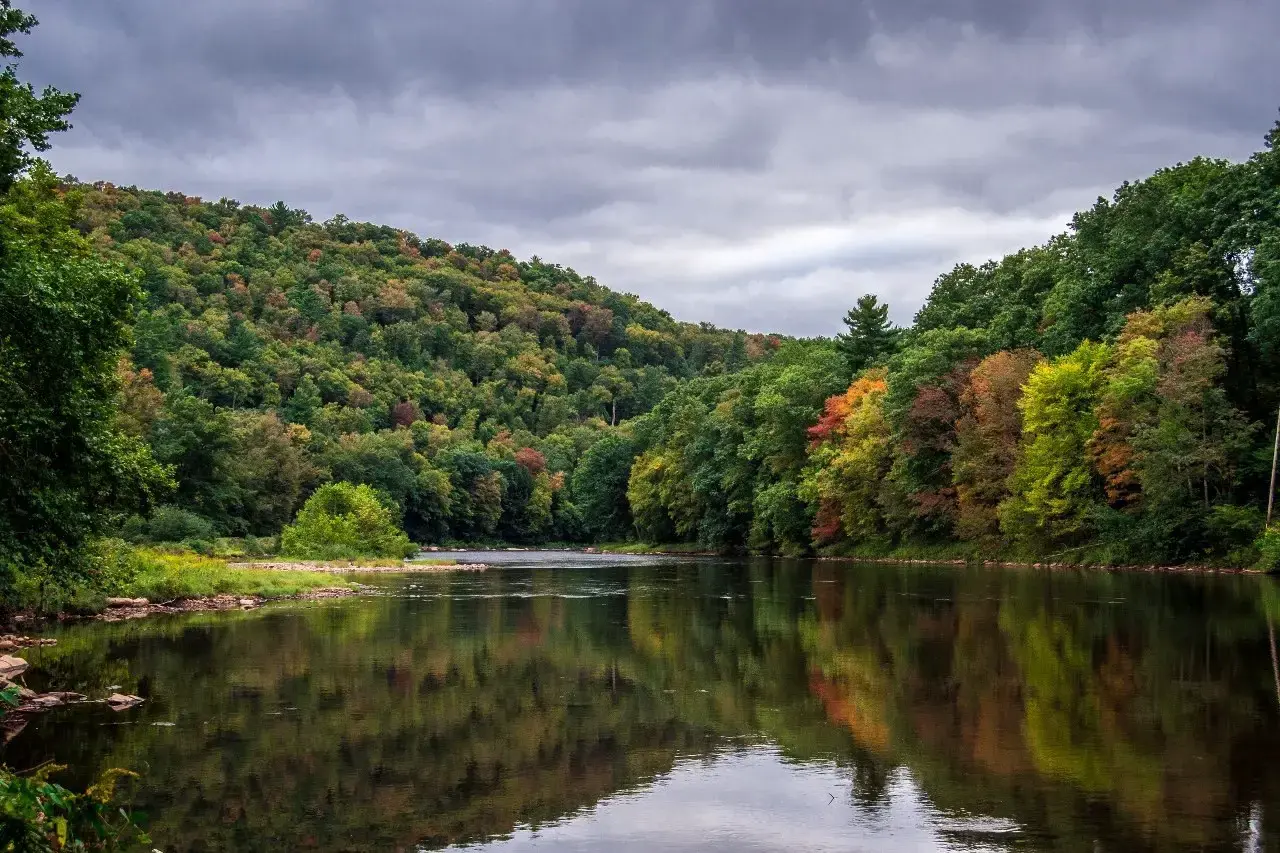
The park experiences a humid continental climate moderated slightly by its sheltered valley location. Winter temperatures average in the 20s to 30s Fahrenheit, with 30 to 40 inches of snowfall. The valley can trap cold air, creating frost pockets that extend the winter season relative to nearby lowlands. Summers are warm with highs in the mid-80s, though the mountain slopes provide shade and cool breezes. Annual precipitation averages about 40 inches. Spring comes somewhat later than in the Cumberland Valley below, and fall foliage peaks in mid-October, when the oaks and maples on Blue Mountain produce vivid displays visible from the valley floor.
Human History
The park's namesake, Colonel William Denning, was a prominent figure in the region during the Revolutionary War era. He operated a charcoal iron furnace along Doubling Gap Run, using the abundant timber and iron ore of the area to produce iron for the Continental Army. The iron industry was a significant economic driver in the Ridge and Valley region during the 18th and 19th centuries, and remnants of charcoal hearths and iron furnace operations can be found throughout the surrounding forests. Before European settlement, the Susquehannock and other indigenous peoples used the mountain passes and valleys as travel corridors between the Susquehanna and Cumberland valleys.
Park History
Colonel Denning State Park was established in 1922 when the Commonwealth of Pennsylvania acquired land in the Doubling Gap area for recreation and forest conservation. The Civilian Conservation Corps developed the park during the 1930s, constructing the dam that created the lake, building a stone beach house, picnic pavilions, and trail infrastructure. Many CCC-era structures remain in use and contribute to the park's rustic Appalachian character. The park has served as a popular mountain getaway for residents of the Cumberland Valley for over a century, and its connection to the Tuscarora Trail provides access to one of the longer side trails of the Appalachian Trail system.
Major Trails and Attractions
The park's lake offers swimming with a seasonal beach and bathhouse, along with fishing for stocked trout and panfish. The Flat Rock Trail climbs from the park to an overlook on Blue Mountain with views of the Cumberland Valley, connecting to the Tuscarora Trail, a 252-mile long-distance trail that runs from Virginia to central Pennsylvania. The Doubling Gap Nature Trail provides an easy loop through the valley floor forest. Several other trails of moderate difficulty traverse the mountain slopes through oak and mountain laurel forests. The park's campground provides a base for multi-day hiking excursions on the Tuscarora and connecting trail systems.
Visitor Facilities and Travel
Colonel Denning State Park is located off Route 233 in Cumberland County, approximately 20 miles west of Carlisle and 40 miles west of Harrisburg. The park offers a campground with over 50 tent and RV sites, flush restrooms, a swimming beach with bathhouse, picnic pavilions, and a small camp store. The park is open year-round, though swimming and some facilities are seasonal. The nearest services are in Newville, about 10 miles east. The park's relatively modest profile keeps it less crowded than some larger state parks, but its proximity to the Harrisburg-Carlisle area makes it a convenient mountain retreat for day trips and weekend camping.
Conservation and Sustainability
Colonel Denning State Park is managed in conjunction with the surrounding Tuscarora State Forest, which provides an extensive forested buffer and wildlife habitat matrix. Water quality in the park's small lake and Doubling Gap Run is monitored regularly, and forest management practices in the surrounding state forest aim to maintain watershed health. Hemlock woolly adelgid has affected hemlock stands in the park's ravines, and treatment efforts are ongoing to preserve specimen trees. The park participates in broader ridge conservation efforts along Blue Mountain, which serves as a critical migratory bird corridor and ecological link in the Appalachian chain. Invasive plant management targets species that encroach along trail corridors and disturbed areas.
Photos
No photos available yet